
Canada boosts Ukraine military aid with C$300M in latest support

It is a chilly Wednesday morning in Ottawa, and as you sip your Double-Double, the headlines are buzzing with numbers that feel significant yet distant.
You might be reviewing a grocery receipt, noting the current cost of staples, while simultaneously reading that Canada boosts Ukraine military aid with C$300M in a fresh round of support.
This highlights a persistent dialogue in Canadian public policy: the balance between international commitments and the immediate economic pressures facing households, such as housing costs and interest rate fluctuations.
Analyzing federal expenditures, I have observed how significant allocations move through the parliamentary process.
This latest announcement is not merely a budgetary entry; it reflects a specific geopolitical strategy.
For the average resident, the interest often lies in the mechanics: the source of these funds and the potential impact on domestic priorities like infrastructure or social services.
Summary of the C$300M Support Package
- Equipment Allocation: A primary focus is placed on 155mm artillery ammunition and unmanned aerial systems (drones).
- Funding Source: Credits are drawn from existing defense envelopes and supplementary departmental estimates.
- Domestic Procurement: A significant portion of this aid is “tied,” meaning the funds are directed toward Canadian defense contractors.
- Cumulative Total: This brings Canada’s total military-related commitments to Ukraine to approximately C$5 billion since 2022.
Why is the government allocating funds amid domestic economic concerns?
The timing of such announcements often leads to questions regarding fiscal priorities. When news breaks that Canada boosts Ukraine military aid with C$300M, the immediate context is often the federal deficit.
From an analytical perspective, the government characterizes this as a “preventative security” measure.
The policy framework suggests that providing targeted aid to contain a localized conflict is a more cost-effective strategy than the long-term economic consequences of a wider regional instability.
It is relevant to note that these funds do not typically leave the country as liquid cash. A substantial portion of the support is reinvested into the Canadian economy.
By procuring equipment from domestic plants in Ontario, Quebec, or the Maritimes, the government fulfills diplomatic pledges while supporting manufacturing jobs.
However, this spending remains part of the broader federal fiscal outlook, which influences the national debt levels and, by extension, the economic environment that affects consumer interest rates.
++ Major Canadian Sporting Events in 2026: From Scotties Tournament of Hearts to U Sports
How does this aid package affect the domestic defense industry?
Military support is intrinsically linked to industrial supply chains. The current C$300 million allocation emphasizes technology and specialized manufacturing.
For those living in innovation corridors such as Waterloo or Montreal, these federal contracts can influence local aerospace and tech sectors.
This creates a specific economic dynamic. While consumer-facing sectors may experience slower growth due to inflation, the defense manufacturing sector often maintains high activity levels driven by these procurement cycles.
This can be viewed as an industrial policy aligned with foreign policy goals. It maintains high-skilled employment within Canada, even though the physical goods are intended for use abroad.
Also read: Spotlight on Indigenous Rights: New Developments Addressing Education, Health & Self-Governance
Is this new spending or a redistribution of existing funds?
A common point of inquiry involves “budgetary reshuffling.”
Often, when Canada boosts Ukraine military aid with C$300M, the funding originates from money previously earmarked for Department of National Defence (DND) projects.
The Canadian Armed Forces (CAF) currently manage various equipment life-cycle challenges, ranging from search-and-rescue aircraft to naval fleet modernization.
By prioritizing this specific aid, the government makes a strategic choice regarding the timeline of domestic procurement.
Delays in the “North Warning System” or tactical vehicle upgrades are sometimes the trade-off for meeting immediate international obligations.
These choices are part of the complex balancing act performed within the federal cabinet and the Treasury Board.
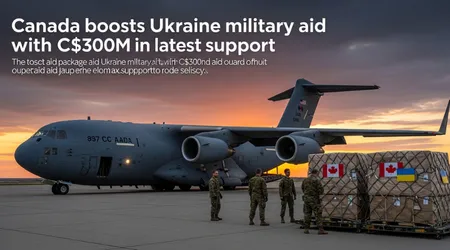
What does the $300M procure for Ukraine in 2026?
The requirements of international defense have evolved. Support in 2026 is less about basic personal protective gear and more about specialized technology.
This includes advanced night-vision systems, cold-weather apparel designed for extreme climates, and electronic warfare countermeasures.
Read more: How Canada Plans to Meet the North Atlantic Treaty Organization 5%-of-GDP Defence Target
The emphasis on artillery production
Artillery remains a central component of high-intensity conflict. Canada has participated in a multi-national effort to stabilize shell production.
A portion of this C$300 million supports the expansion of manufacturing lines at facilities like IMT Defence.
This serves a dual purpose: it meets immediate international demand and assists in replenishing Canada’s own depleted stocks, ensuring the CAF maintains its own readiness levels.
The role of Canadian drone technology
Canada is recognized for its expertise in imaging and sensor technology. The “eyes in the sky” provided through this aid utilize Canadian-engineered optics.
For the taxpayer, this indicates that the aid is a vehicle for exporting high-value intellectual property.
It supports a niche in the global market for Canadian engineering while providing technical capabilities to a partner nation.
The Household Perspective: A Practical Comparison

Consider the scenario of a family in Burlington, Ontario. They are closely managing a household budget in the face of 2026 price levels. To them, $300 million represents a vast sum of public money.
Economic Context: While this allocation does not directly cause a spike in local prices, it contributes to the total federal spending volume.
The Statistical Breakdown: This $300M represents roughly $7.50 per Canadian resident. While this specific amount is a fraction of the total federal budget, the cumulative effect of various international and domestic spending programs dictates the federal deficit’s trajectory.
The analytical takeaway is that the government balances these “diplomatic costs” against the need for domestic social license.
Public support for such measures often depends on how clearly the government communicates the link between international stability and domestic economic security.
Comparing Canada’s Support: 2024 vs. 2026
| Feature | 2024 Support Cycle | 2026 Support Cycle (Current) |
| Total Amount | C$2.4 Billion (Total Annual) | C$300 Million (Periodic Increment) |
| Primary Focus | Heavy Armor & Tanks | Precision Drones & Artillery |
| Economic Mechanism | Drawdown of Existing Surplus | New Domestic Production |
| Strategic Goal | Immediate Defensive Support | Sustained Technical Capability |
| Procurement Origin | Mixed Global/Domestic | Heavily Canadian-manufactured |
The news that Canada boosts Ukraine military aid with C$300M confirms a sustained role for the country in international security.
However, this requires a transparent discussion about the trade-offs involved. This is not “extra” money; it is a choice within a finite budget.
As we navigate the remainder of 2026, the effectiveness of this policy will likely be measured by its impact on the ground abroad and its ability to maintain the trust of Canadians who are concurrently managing their own financial resilience.
Government communication regarding the “Industrial Return” of these investments is essential.
Understanding how these contracts support local jobs provides a clearer picture of the total impact of Canada’s foreign policy on the domestic economy.
Maintaining this clarity is necessary for a balanced public discourse.
Frequently Asked Questions
Does this aid result in a direct tax increase?
No, there is no specific “Ukraine tax.” The funds are allocated from the general federal revenue pool. However, all federal spending influences the government’s overall debt-to-GDP ratio.
Is the equipment being sent new or used?
In the 2026 cycle, there is a distinct shift toward brand-new procurement. While early aid utilized older CAF surplus, current packages often involve ordering new technology directly from Canadian manufacturers.
Why is money sent abroad instead of to local infrastructure?
Federal budgets are divided into many envelopes. Defense and international aid are separate from provincial infrastructure transfers.
However, critics often point to the “opportunity cost” the idea that funds used in one area are unavailable for another.
How is the delivery of this equipment tracked?
The Department of National Defence and international monitoring bodies track the delivery and end-use of military goods to ensure they reach the intended recipients and are used according to international law.
Can these funds be redirected if Canada enters a recession?
Spending of this nature is discretionary. In a significant economic downturn, the federal government has the authority to adjust international spending to prioritize domestic stimulus or social safety nets.