
How provincial child benefits Canada vary across regions 2026

Imagine you’re a young parent in a bustling suburb of the GTA, staring at a stack of bills while your toddler tries to use a crayon on the living room wall.
You’ve heard that the Canada Child Benefit (CCB) is going up in July 2026, but then you chat with your cousin in Quebec or your buddy who just moved to Calgary, and you realize their monthly checks look completely different from yours.
It’s enough to make any Canadian scratch their head and wonder if they’re getting their fair share of the “loonie” pie.
The reality is that while the federal government sets the baseline, every province plays its own game with your family’s budget.
Understanding how provincial child benefits Canada vary across regions is the difference between leaving money on the table and maximizing your household income for the year ahead.
Navigating the 2026 Benefit Landscape
- The Federal Foundation: How the CCB sets the 2026 baseline for all families.
- Provincial Powerhouses: Why Quebec and Ontario offer such vastly different supplemental amounts.
- The Western Advantage: Breaking down the Alberta and BC “working component” shifts.
- The Practical Case: A real-world look at the dollar-for-dollar difference between provinces.
Why does your postal code matter for your child’s bank account?
In my years of tracking Canadian fiscal policy, the most common misconception is that the CCB is a “one-size-fits-all” program. It isn’t.
While the Canada Revenue Agency (CRA) handles the heavy lifting, provinces tack on their own specific benefits to address local costs of living, regional poverty rates, and even political priorities.
What many forget to observe is that these provincial top-ups are often “clawed back” at different income thresholds than the federal benefit.
This means that as you earn more, your provincial benefit might vanish long before your federal one does.
For 2026, we are seeing a widening gap as provinces like British Columbia lean into temporary enhancements to fight inflation, while others remain stagnant.
My recommendation for you is to stop looking only at the “maximum” amount. You need to look at the “phase-out” rate.
A province might offer a high initial benefit, but if they take away 5 cents for every dollar you earn above $30,000, that benefit is effectively useless for a middle-class family.
++ What Canada benefit stacking rules mean for low-income earners
How do provincial child benefits Canada vary across regions in 2026?
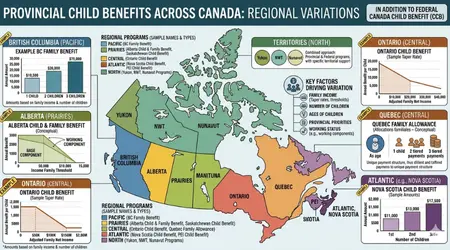
When we look at the numbers for the July 2025 to June 2026 benefit year, the disparities are striking.
The federal CCB provides a maximum of $7,997 per year for a child under six, and $6,748 for children aged six to 17. But once you add the provincial layer, the math changes.
The Ontario Perspective
Ontario families often feel the pinch of the highest housing costs in the country. The Ontario Child Benefit (OCB) offers up to $1,726.92 per year (about $143.91 per month) per child.
However, this is strictly aimed at lower-income families. If your family income exceeds roughly $25,000, you’ll see this amount start to dwindle.
The Quebec “Family Allowance” Model
Quebec remains the outlier and arguably the leader in family support.
Unlike other provinces, Quebec manages its own “Family Allowance” through Retraite Québec. For 2026, a two-parent family with a net income under $60,000 can receive a maximum of $3,068 per child annually.
This is significantly higher than the Ontario equivalent.
Quebec also provides a unique “Supplement for the Purchase of School Supplies,” which is a flat $127 per child, something you won’t find in the Maritimes or the Prairies.
Also read: How Auto-Enrollment of Federal Benefits (2026 Onwards) Will Help Low-Income Canadians
The Western Shift: Alberta and BC
Alberta’s Child and Family Benefit (ACFB) is unique because it includes a “working component.” If you earn over $2,760, your benefit actually increases as you work more, up to a certain point.
For 2026, the maximum base component for one child is $1,499, plus a working component of $767, totaling roughly $2,266.
In British Columbia, the BC Family Benefit has been enhanced to combat the “living in BC tax.” For families earning under $29,526, the first child can bring in $1,750 annually.
What’s interesting here is that BC has higher income thresholds for middle-class families compared to Ontario, meaning you might keep a partial benefit even if you’re making six figures.
Comparison Table: Provincial Maximums (Under 18) 2026
| Province | Max. Annual Benefit (Per Child) | Income Threshold for Max. | Key Feature |
| Ontario | $1,726.92 | ~$25,000 | Direct monthly CRA payment. |
| Quebec | $3,068.00 | $60,000 (Two-parent) | Separate provincial administration. |
| Alberta | $2,266.00 | $28,116 (Base) | Includes a “working component.” |
| BC | $1,750.00 | $29,526 | High middle-income phase-out. |
Case Study: The “Moving Van” Math
Let’s look at a hypothetical family Sarah and Mike. They have two children, aged 4 and 8, and a combined adjusted family net income of $45,000.
- In Ontario: They would receive the full CCB (approx. $14,745) plus a partial Ontario Child Benefit. Because they earn over the $25k threshold, their OCB would be reduced, likely leaving them with about $2,800 in provincial support.
- In Quebec: Because Quebec’s threshold for the maximum amount is higher ($60,000), they would receive the full $3,068 for the first child and the second child (approx. $6,136 total).
The difference is over $3,300 per year just for living on the other side of the Ottawa River. On a practical level, that covers three months of groceries or a significant chunk of childcare.
This is why I always tell my readers: don’t just “file and forget.”
You need to understand your province’s specific “income tests” because a small change in your RRSP contributions could actually bump your “net income” down enough to trigger a higher provincial benefit tier.
Why are some provinces more “generous” than others?
The reason provincial child benefits Canada vary across regions usually comes down to two things: the provincial tax base and the local cost of daycare.
Quebec, for instance, has long prioritized “family-first” policies to encourage population growth. They tax more heavily, but they reinvest it into these direct transfers.
On the other hand, provinces like Alberta use the “working component” to encourage labor force participation. It’s a subtle nudge from the government:
“We will help you more if you are actively earning.” In my analysis, this creates a “benefits cliff” in some provinces where earning an extra $1,000 at work might actually cause you to lose $1,200 in combined federal and provincial benefits.
It’s a “poverty trap” that we experts are constantly flagging to the government.
Navigating the 2026 Fiscal Year
Understanding that provincial child benefits Canada vary across regions is step one in taking control of your family’s finances.
We are living in an era of “targeted relief,” where the government isn’t just handing out money they are surgically placing it based on income, location, and employment status.
My final piece of advice? Use the “CRA Child and Family Benefits Calculator” every time your income changes by more than 5%. It’s the only way to avoid the dreaded “overpayment” notice in the mail.
We’re all trying to make ends meet in this high-inflation environment, and in 2026, being “benefit-literate” is a high-income skill in its own right.
Keep your eye on the July 2026 updates, and make sure you’re getting every nickel your province owes you. After all, you’re the one doing the hard work of raising the next generation of Canadians you’ve earned that support.
FAQ: What you need to know for the 2026 Tax Season
How do I apply for these provincial benefits?
For most Canadians, you don’t have to do anything extra. As long as you file your annual tax return and apply for the federal CCB, the CRA automatically calculates your provincial portion (except in Quebec).
Why did my BC Family Benefit drop in July?
Benefits are recalculated every July based on the previous year’s tax return. If you got a raise in 2025, your July 2026 check will likely be smaller because your “Adjusted Family Net Income” (AFNI) went up.
Does the “Canada Groceries and Essentials Benefit” affect my child benefits?
No. These are separate credits. Starting in July 2026, the grocery benefit will see a 25% increase, but this is paid out quarterly and does not count toward your income for child benefit calculations.
Will moving provinces mid-year affect my payments?
Yes. You are required to notify the CRA (or Retraite Québec) immediately when you move.
Your benefits will be adjusted to the rates of your new province starting the following month. Don’t “double dip,” or you’ll face a nasty bill at tax time.